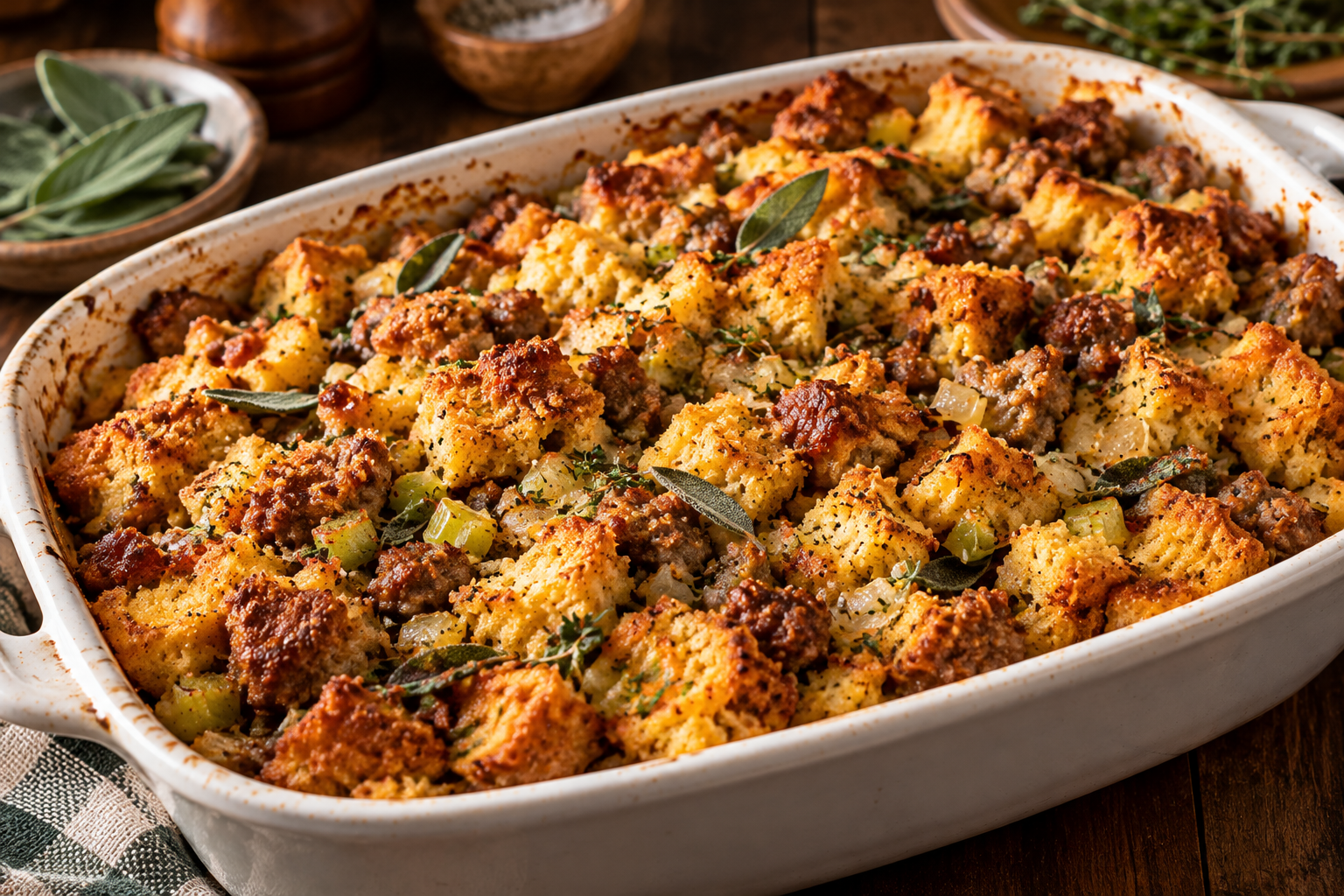
Southern Sausage Cornbread Stuffing with Sage and Butter

Day-old cornbread, browned breakfast sausage, celery, onion, sage, and buttery broth bake into a Southern-style stuffing with a tender center and crisp golden edges.
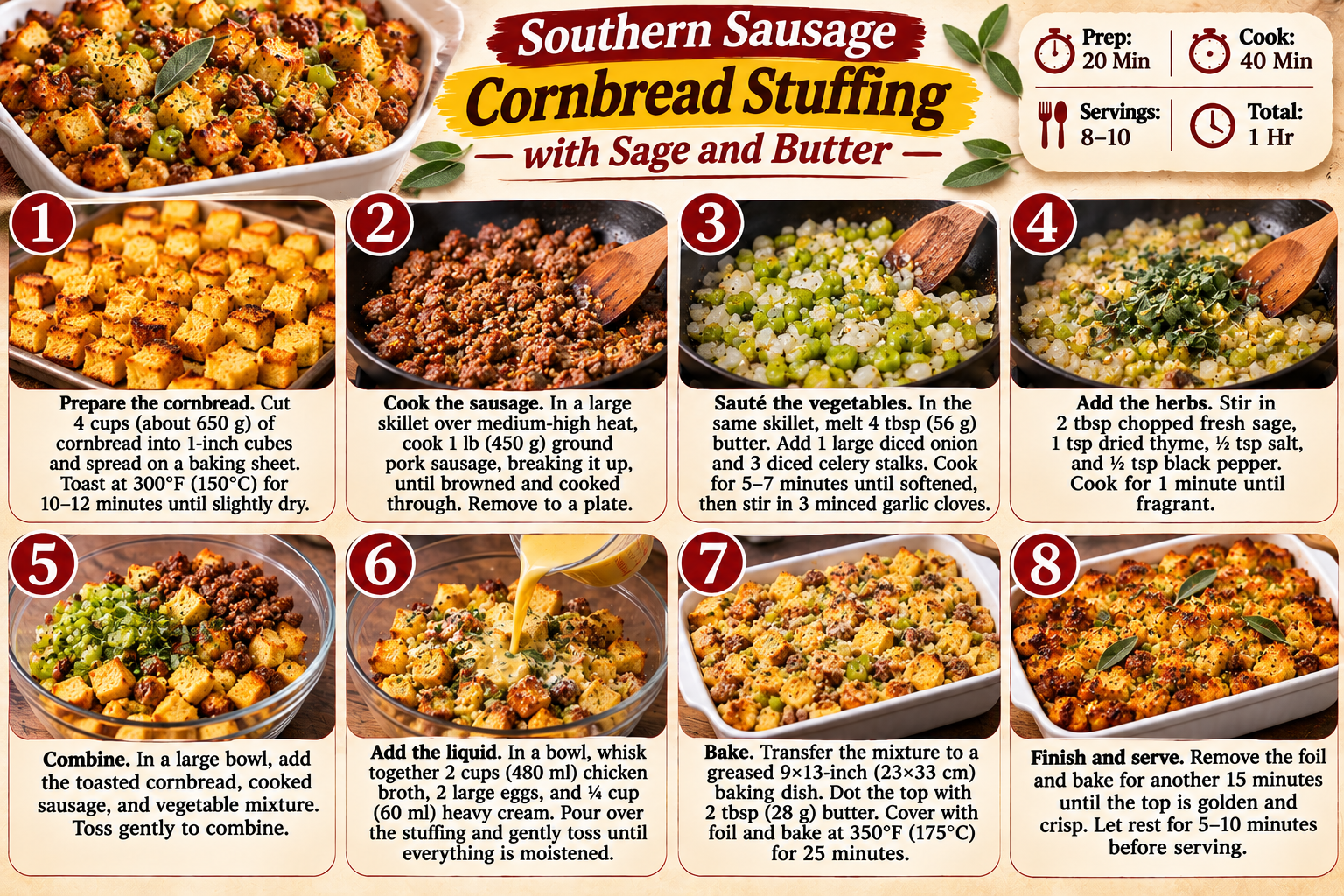
Southern Sausage Cornbread Stuffing with Sage and Butter
Southern sausage cornbread stuffing is a savory, herb-scented side dish built around tender cubes of cornbread, browned breakfast sausage, softened onion and celery, and a buttery broth mixture. The top turns golden in the oven while the center stays moist without becoming soggy. Fresh sage and thyme give the stuffing its familiar holiday aroma, and parsley adds a clean finish.
This version is baked in a 9-by-13-inch dish and serves eight. It uses day-old cornbread, which absorbs broth while holding its shape. If your cornbread is fresh, a short drying step in the oven prepares it for the liquid. The broth is added gradually rather than all at once because cornbread recipes vary in density and absorbency. The result should be evenly moist, not swimming in liquid. Plan for about 1 hour and 15 minutes, including the short resting time after baking.
Why You’ll Enjoy This Recipe
It has a satisfying mix of textures. Cornbread softens as it absorbs the seasoned broth, while the top and edges bake into a lightly crisp layer. Browning the sausage first adds savory bits throughout the dish.
The flavor comes from familiar ingredients. Onion, celery, garlic, sage, thyme, and butter create a savory base without relying on canned soup. The sausage adds seasoning and richness, so the mixture needs to be tasted before adding extra salt.
It suits a holiday menu but is not complicated. Most of the work happens in a skillet and a mixing bowl. Once the cornbread, sausage, vegetables, eggs, and broth are combined, the oven does the rest.
You can prepare it ahead. The dish can be assembled and refrigerated for up to 24 hours before baking. That makes it easier to organize a meal when oven and stovetop space are limited.
Ingredients You’ll Need
Day-old cornbread (8 cups / about 450 g), cut into ¾-inch cubes: Slightly dry cornbread absorbs broth without immediately collapsing. If yours is freshly baked, dry the cubes in a low oven before mixing.
Breakfast sausage (12 oz / 340 g): Use mild or hot sausage with the casings removed. Brown it fully and break it into small pieces so the flavor is distributed through the stuffing.
Unsalted butter (4 tablespoons, plus 1 tablespoon for greasing): Butter softens the vegetables and carries the sage and thyme through the mixture. Grease the baking dish with the additional tablespoon.
Yellow onion (1 medium), celery (3 ribs), and garlic (2 cloves): Dice the onion and celery finely so they soften evenly. Mince the garlic and add it after the onion and celery have begun to soften to prevent it from browning too quickly.
Fresh sage (1 tablespoon or 1 teaspoon dried), thyme (1 teaspoon fresh or ½ teaspoon dried), black pepper (½ teaspoon), and kosher salt (½ teaspoon, plus more to taste): Sage is the signature herb here, while thyme adds a subtle earthy note. Start with the measured salt and adjust only after considering the saltiness of the sausage and broth.
Eggs (2 large) and low-sodium chicken broth (2 cups, plus up to ½ cup more): Eggs help the stuffing set. Use broth gradually; the mixture should feel moist throughout but should not pool liquid at the bottom of the bowl.
Fresh parsley (2 tablespoons): Chopped parsley adds color and freshness to the sausage and herb mixture.
Equipment
Gather a 9-by-13-inch baking dish, a rimmed sheet pan, a large skillet, a large mixing bowl, a whisk, foil, a chef’s knife, a cutting board, and an instant-read thermometer. A wide bowl makes it easier to fold the cornbread gently without crushing it. The thermometer is useful for checking that the center reaches 165°F (74°C).
How to Make Southern Sausage Cornbread Stuffing
- Prepare the oven and cornbread. Heat the oven to 350°F (175°C) and butter a 9-by-13-inch baking dish with 1 tablespoon butter. Spread the 8 cups of cornbread cubes on a sheet pan and bake for 8–10 minutes, until the surface feels dry but the cubes are not deeply browned. Set aside.
- Brown the sausage. Cook 12 ounces sausage in a large skillet over medium heat for 6–8 minutes, breaking it into small pieces, until fully cooked and no pink remains. Transfer it to a bowl, leaving about 1 tablespoon of drippings in the skillet. Drain excess fat if there is more.
- Soften the vegetables. Add 4 tablespoons butter to the skillet. Stir in the diced onion and celery and cook for 6–8 minutes until softened. Add the minced garlic, sage, thyme, black pepper, and salt. Cook for about 30 seconds, just until fragrant.
- Combine the dry ingredients. Place the toasted cornbread and cooked sausage in a large mixing bowl. Add the buttery vegetable mixture and chopped parsley. Toss gently so the cornbread remains in pieces.
- Add the broth and eggs. Whisk 2 eggs with 2 cups broth. Pour the liquid over the cornbread in stages, folding gently between additions. Let the mixture stand for 5 minutes. If dry patches remain, add up to ½ cup more broth. The cubes should be moist but not submerged.
- Fill the baking dish. Spoon the mixture into the prepared dish and spread it evenly without packing it down. Cover tightly with foil to keep the center moist during the first part of baking.
- Bake covered, then uncovered. Bake for 25 minutes covered. Remove the foil and bake another 20–25 minutes, until the center is hot, the top is golden, and the edges are crisp. Check that the center reaches 165°F (74°C).
- Rest before serving. Let the stuffing rest for 10 minutes so it settles and is easier to scoop. Add a little extra parsley if desired.
Tips and Troubleshooting
Start with dry cornbread. Day-old cornbread is ideal because it absorbs broth without turning to paste. If yours is fresh, cube it and dry it in a 300°F (150°C) oven for 20–25 minutes. Let it cool before mixing.
Add broth in stages. Cornbread can be crumbly or dense depending on the recipe. Begin with 2 cups, fold gently, and wait five minutes before deciding whether more is needed. The mixture should be evenly moist but not wet enough to release a puddle when pressed.
Do not overmix or pack the dish. Folding keeps some cornbread pieces intact, which gives the finished stuffing texture. Pressing it tightly into the baking dish can make the center heavy and slow to heat.
Watch the salt. Breakfast sausage and broth may already contain a good amount. Use low-sodium broth when possible and taste the cooked vegetable mixture before adding extra salt.
Check the center, not just the top. A golden surface does not guarantee that the middle is hot. The center should reach 165°F (74°C), particularly because the recipe includes cooked sausage and eggs.
Easy Variations
Use turkey sausage for a lighter-tasting variation, or a plant-based sausage if you want to avoid pork. Vegetable broth can replace chicken broth. For a gluten-free version, use cornbread made with a gluten-free recipe and check the sausage and broth labels. Dried sage can replace fresh sage at the one-third quantity specified. You can also add a little chopped parsley for freshness, but keep the core balance of cornbread, sausage, vegetables, herbs, and broth intact so the stuffing sets properly.
What to Serve With It
This stuffing belongs naturally beside roast turkey, chicken, ham, or pork. It also pairs well with green beans, roasted carrots, cranberry sauce, mashed potatoes, and a simple salad. Because it is rich and savory, serve it with a bright or acidic side to balance the plate. For a smaller meal, pair a scoop with roasted vegetables and a green salad.
Make-Ahead, Storage, and Reheating
To make it ahead, prepare the cornbread, sausage, and vegetable mixture, combine everything with the eggs and broth, and transfer it to the baking dish. Cover tightly and refrigerate for up to 24 hours. Before baking, check whether the cornbread has absorbed the liquid; add a small splash of broth if it looks dry. Bake from chilled and allow an extra 5–10 minutes as needed, checking the center temperature.
Refrigerate leftovers within two hours in an airtight container for 3–4 days. Reheat covered in a 325°F (165°C) oven with a splash of broth until the center reaches 165°F. Uncover briefly at the end to refresh the top. You can freeze baked stuffing for up to two months. Thaw overnight in the refrigerator and reheat thoroughly. The texture is best when the stuffing is freshly baked, but careful reheating keeps leftovers moist.
Frequently Asked Questions
Can I assemble cornbread stuffing the day before?
Yes. Assemble it without baking, cover tightly, and refrigerate for up to 24 hours. Check moisture before baking and add a little broth if needed. It may need 5–10 extra minutes because it starts cold.
How wet should the stuffing mixture be?
The cornbread should be moist throughout and beginning to soften, but it should not sit in a pool of broth. Add liquid gradually because different cornbread recipes absorb different amounts.
What temperature should sausage stuffing reach?
The center should reach 165°F (74°C). Use an instant-read thermometer inserted into the middle of the dish.
A Comforting Side for the Holiday Table
Southern sausage cornbread stuffing is most successful when the bread is dry enough to absorb broth, the vegetables are softened in butter, and the liquid is added with a light hand. Give it a covered bake to warm the center, then uncover it to create crisp golden edges. Rest the dish briefly before serving, and you will have a savory, herb-filled side that fits comfortably into a holiday meal or a Sunday dinner.
Ready to make something?
Turn inspiration into dinner.
Browse our tested recipes for practical step-by-step ideas, weeknight favorites and something delicious to try next.
Find your next recipe →Helpful Tools for This Recipe
Disclosure: Affiliate disclosure: This post contains affiliate links. As an Amazon Associate I earn from qualifying purchases at no extra cost to you.
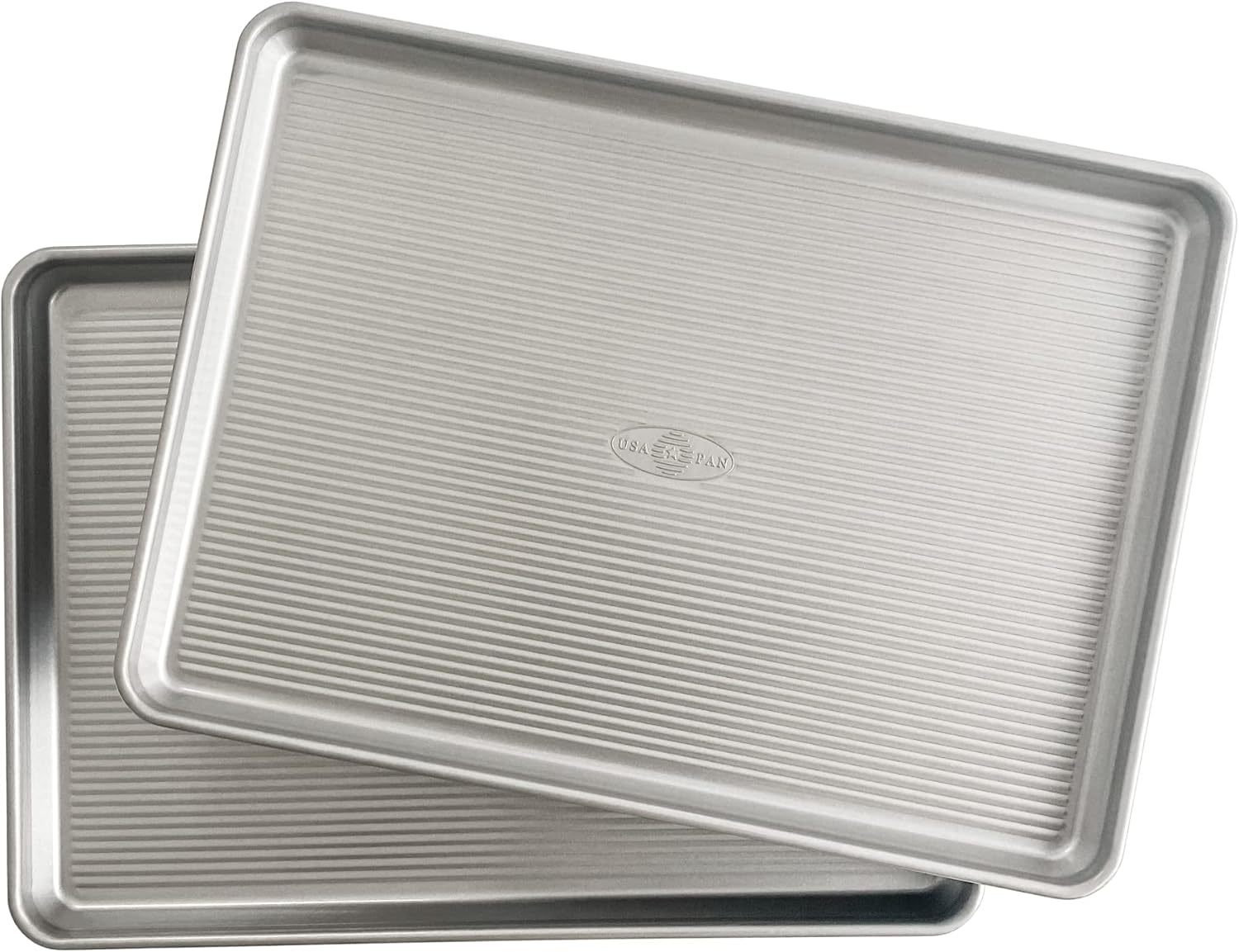 (paid link)
Heavy-Duty Half Sheet Baking Pans (Set of 2)
Heavy-gauge aluminum prevents warping at high heat for even sheet-pan dinners and golden rolls.
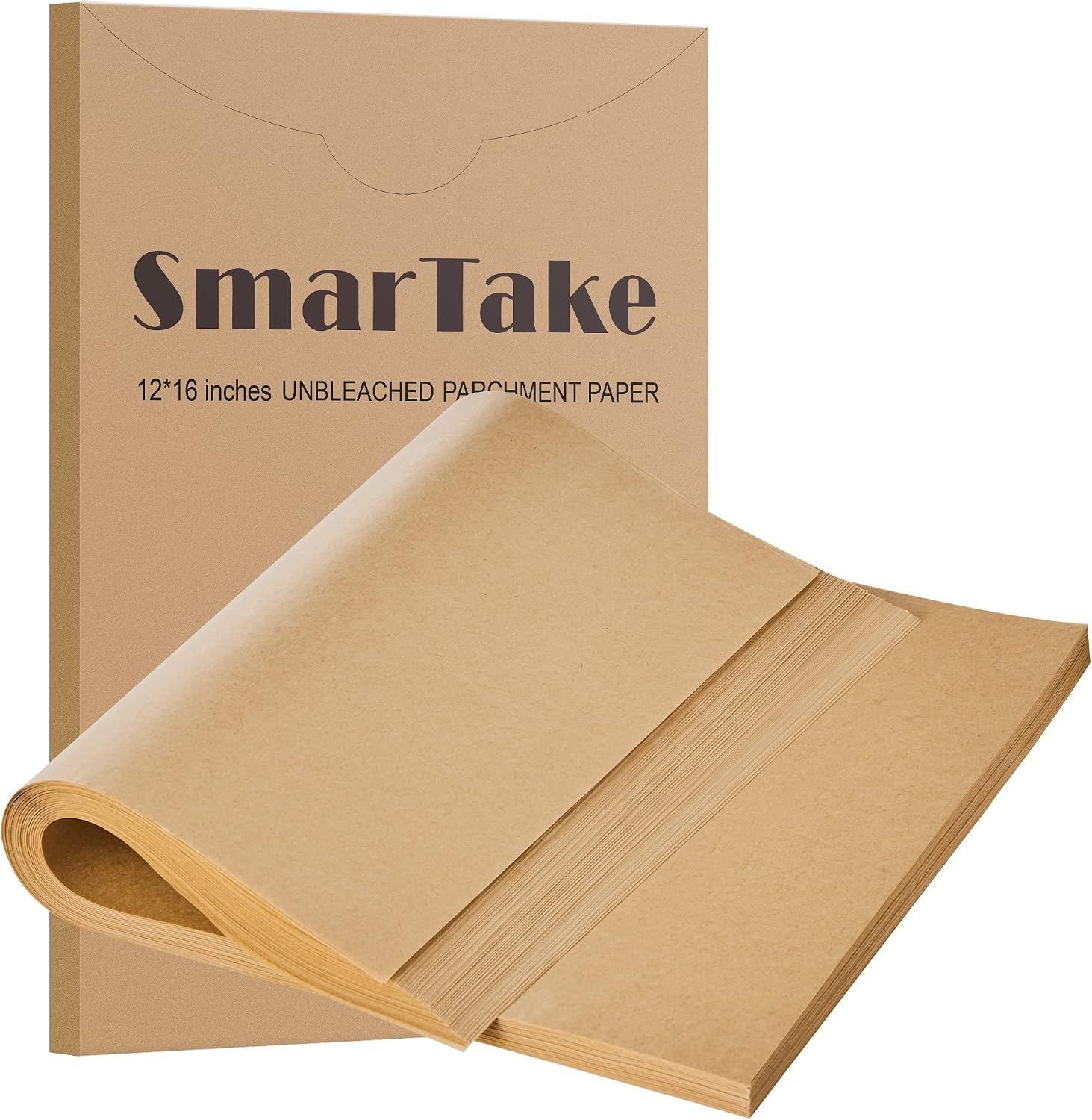 (paid link)
Unbleached Pre-Cut Baking Parchment Paper Sheets
Lies completely flat on baking trays for effortless release with zero sticking and swift cleanup.
 (paid link)
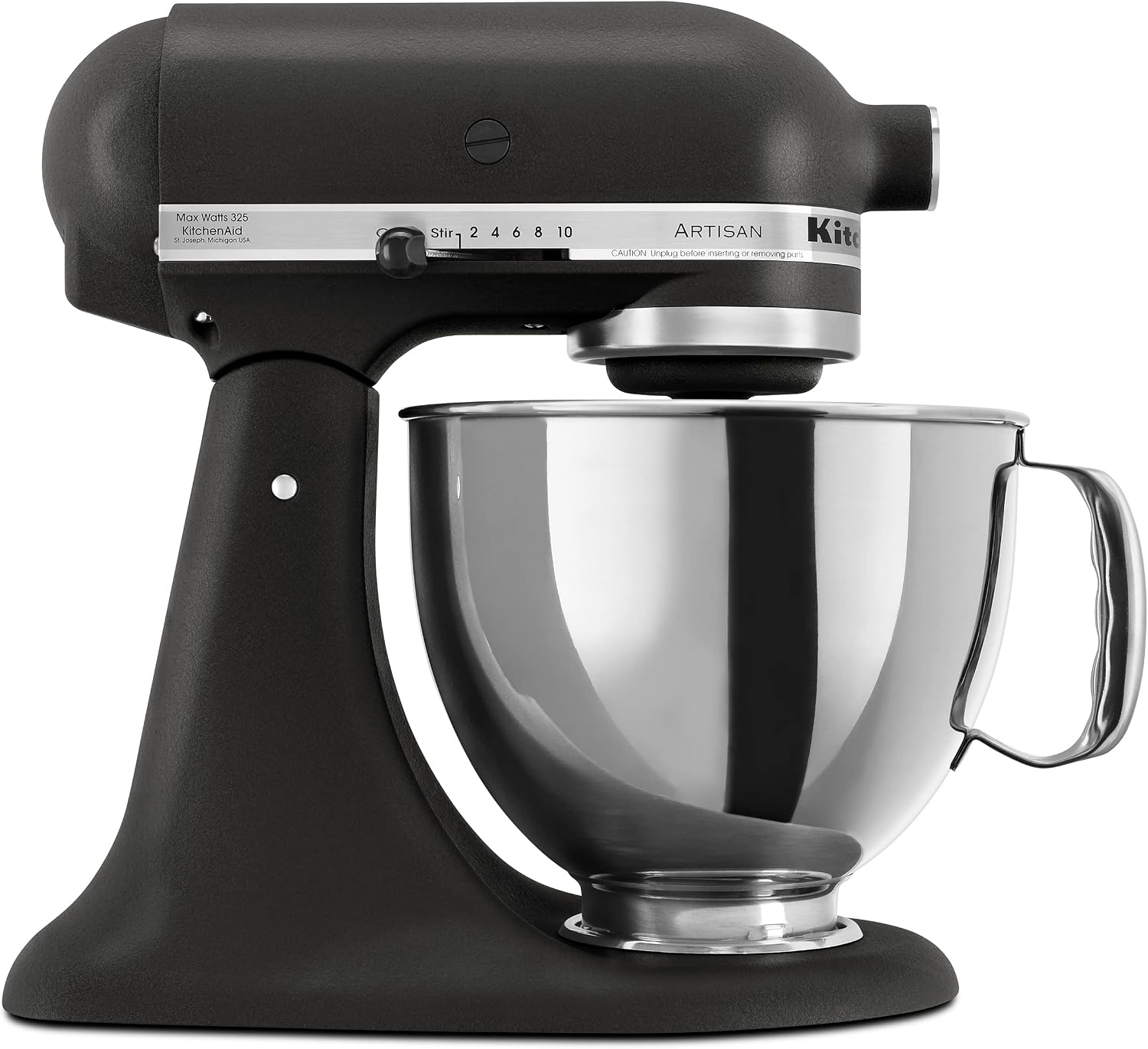
Tilt-Head Stand Mixer (5-Quart)
Whips batters, kneads doughs, and creams butter hands-free for professional-quality baked goods.